
Junera™ Technology
Dual-WavelengthLaser Science
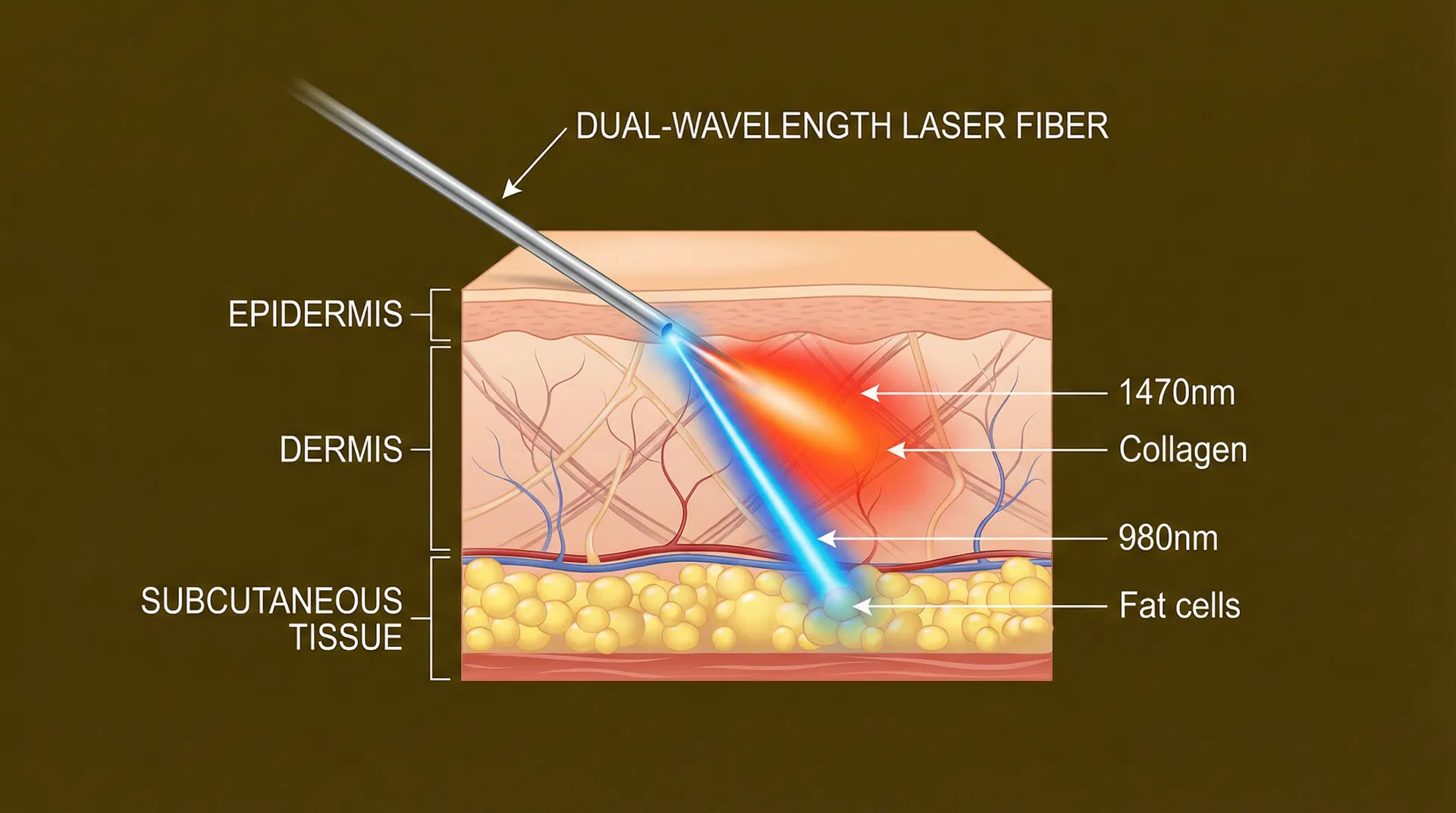
Two wavelengths. One precision system. 980nm dissolves fat with concurrent tissue contraction. 1470nm stimulates your body's own collagen production, increasing dermis density by up to 48.75%. Delivered beneath the skin through ultra-thin fiber optics — directly to the tissue plane where structural remodeling begins.
Wavelength Science
Two Wavelengths, One Precision System
Junera's fiber optic delivers laser energy exactly where it's needed — at the subdermal plane, with wavelength-specific precision and direct tissue targeting. Each wavelength is selected for specific chromophore absorption, producing predictable, measurable outcomes.
980nm Wavelength
EraSculpt™ Mode
The 980nm wavelength delivers targeted fat reduction through selective absorption by lipid-rich tissue. Subdermal precision dissolves stubborn volume with concurrent tissue contraction — sculpting from within while simultaneously providing hemostasis to minimize bruising.1
Across 534 documented procedures, Reynaud et al. confirmed subdermal fat dissolution with simultaneous tissue contraction — achieving 80% patient satisfaction (published case series) with rapid recovery and zero serious adverse events.1
Primary Chromophore Targets
- Hemoglobin— Vascular coagulation & hemostasis
- Lipids— Selective fat cell disruption
- Water (moderate)— Tissue heating for contraction
Primary Chromophore Targets
- Water (high)— Deep dermal heating & remodeling
- Collagen— Thermal contraction & neocollagenesis
- Extracellular matrix— Structural tissue reorganization
1470nm Wavelength
EraLift™ Mode
The 1470nm wavelength stimulates your body's own collagen production through its exceptionally high affinity for intracellular water. Delivered subdermally, it triggers architectural skin remodeling — rebuilding the dermis from the inside out through initial collagen contraction followed by long-term neocollagenesis.4
Clinically proven to increase dermis density by up to 48.75% — measured by ultrasound, not estimated.2 A separate study on nasolabial folds showed 43.75% denser dermis with 100% patient satisfaction and 26.78% wrinkle volume reduction.3 Your dermis, rebuilt — measurably transformed.

Dual-Wavelength Synergy
EraDefine™: The Power of Both
Simultaneous contouring and tightening in a single session. The 1470nm rebuilds your skin's architecture while the 980nm sculpts from within.6 Structural rejuvenation — sculpt, tighten, and rebuild in one procedure, with zero serious adverse events across 15+ peer-reviewed studies.
Mechanism of Action
How Subdermal Laser Remodeling Works
Fiber Insertion
A thin optical fiber (400–800μm, selected by treatment area) is inserted subdermally through a micro-incision or cannula entry point, positioned within the target tissue layer. Fiber sizes: 400μm for periorbital, 600μm for face/neck, 800μm for body.
Energy Delivery
Controlled laser energy is delivered in a fan-like pattern. The physician selects wavelength mode based on anatomical target — fat, dermis, or both.
Tissue Response
Initial collagen contraction occurs at the dermal level. Adipose tissue undergoes controlled lipolysis. Hemostasis minimizes bruising and downtime.5
Remodeling Phase
Over 3–6 months, neocollagenesis produces new collagen fibers, resulting in progressive skin tightening and improved tissue quality.4
The Platform
Junera™ Dual-Wavelength Laser System
Purpose-built for subdermal precision. The Junera platform features an intuitive touchscreen interface with dedicated Face and Body treatment modes, integrated fiber optic delivery, and dual-wavelength selection — all in a compact, mobile-ready console.
Ultra-thin fiber optics (400–800μm) thread through a precision handpiece, delivering laser energy directly to the tissue plane. The 400μm fiber reaches the periorbital zone — where no other device can safely operate.

Safety Profile
Favorable Safety with Proper Technique
Across all reviewed clinical studies, the procedure is consistently reported as safe. Most adverse events are mild and transient, including temporary edema, ecchymosis, and discomfort that resolve within days.57
Serious complications such as burns or nerve damage are rare and are almost always attributed to improper technique — specifically excessive energy delivery or inadequate thermal monitoring.8 The Elicit systematic review of 31 studies confirmed 80–93% patient satisfaction across published case series with a strong safety profile when proper protocols are followed.5
"Keeping skin surface temperature below 40–45°C is critical to avoiding complications."
Optimal Parameters
Evidence-Based Energy Dosage
| Parameter | Guideline |
|---|---|
| Optimal Fluence (1470nm) | 20 J/cm² |
| Thermal Damage Threshold | 40 J/cm² (signs of damage) |
| Surface Temp. Limit | Below 40–45°C |
| Fiber Diameter | 400–800μm (400 periorbital, 600 face/neck, 800 body) |
| Anesthesia | Local tumescent |
| Patient Satisfaction | 80–93% across studies |
FDA 510(k) Cleared
Junera's dual-wavelength diode laser platform holds FDA 510(k) clearance for soft tissue coagulation and laser assisted lipolysis across multiple medical specialties.9
Manufactured by Triangel RSD Limited (Est. No. 3027605646). Distributed in the U.S. by Onyxa Medical®.
Soft Tissue Coagulation
Incision, excision, vaporization, ablation, hemostasis
Laser Assisted Lipolysis
Non-contact mode during general surgery procedures
Device Specifications (per 510(k))
Full biocompatibility testing passed per ISO 10993 standards — cytotoxicity, irritation, sensitization, acute systemic toxicity, pyrogen, and hemolytic testing all confirmed safe.9
References
- 1Reynaud JP, Skibinski M, Wassmer B, Rochon P, Mordon S. "Lipolysis using a 980-nm diode laser: a retrospective analysis of 534 procedures." Aesthetic Plastic Surgery, 2009. DOI: 10.1007/s00266-008-9262-xView study
- 2Nilforoushzadeh MA, Heidari-Kharaji M, Najar Nobari N, Torkamaniha E, Rafiee S, Shahverdi M, Tehrani S, Fakhim T. "Treatment of horizontal neck wrinkles by Endolift laser: Biometric measurement." Journal of Cosmetic Dermatology, 2023.View study
- 3Nilforoushzadeh MA, Heidari-Kharaji M, Fakhim T, Hosseini ST, Rafiee S, Shahverdi M, Najar Nobari N. "Efficacy evaluation of endolift laser for treatment of nasolabial folds and marionette lines." Journal of Cosmetic Dermatology, 2023.View study
- 4Bollero D, Orlando G, Dell'Avanzato R, Cambieri I, Bovani B, Minzon S, Forte R, Senetta R, Scutera S, Musso T. "In vivo pilot study of the effects of a subdermal 1470 nm diode laser on human skin." Aesthetic Plastic Surgery, 2014. DOI: 10.1007/s00266-014-0393-2View study
- 5Elicit Research (AI-assisted systematic review). "Aesthetic Applications of Interstitial Laser Therapy using a 980/1470 nm laser." Elicit Research Report, 2024. Systematic review of 31 studies (499 papers screened).View study
- 6de Moura AO, Borges FS, de Moura AC. "Endolaser Treatment of Aesthetic Disorders: Clinical Experience of 4 Years." Lasers in Surgery and Medicine, 2023.View study
- 7Elicit Research (AI-assisted systematic review). "Mechanisms of Action in Laser-Assisted Skin Tightening." Elicit Research Report, 2024.View study
- 8"Complications from Laser Endolift Use: Case Report." Clinical case report, 2023. Documents complications from improper technique; reinforces importance of thermal monitoring (<40°C surface) and adherence to energy parameters (8–14 J/cm³).View study
- 9FDA 510(k) Clearance K212734. Junera dual-wavelength diode laser therapy device. Cleared June 6, 2023. Classification: Powered Laser Surgical Instrument, 21 CFR 878.4810, Product Code GEX, Class II. Dual wavelength 980nm/1470nm. Indications: 980nm for soft tissue coagulation in dermatology, general surgery, plastic surgery, gynecology, urology, ENT, dental, gastroenterology, podiatry and laser-assisted lipolysis. 1470nm for treatment of saphenous vein reflux.
See the Clinical Results
Browse real before & after results from Junera treatments performed by trained providers.
View Clinical Results